Journal · Connectivity · 23 Sep 2026
Bright Hill Becomes an Interchange in 2030. Here’s What Changes.
Today Bright Hill is a stop on one line. In 2030 it becomes the western end of another. The difference between those two sentences is worth understanding before you price any home nearby.
What actually opens in 2030
Cross Island Line Phase 1 runs 29 kilometres from Aviation Park in the east to Bright Hill, with twelve stations. Construction began in January 2023 and the line is slated to open in 2030. Bright Hill, already TE7 on the Thomson-East Coast Line, takes on a second code, CR13, and becomes the phase’s terminus interchange.
Follow the line east and the map reorganises itself. Pasir Ris connects to the East-West Line. Hougang connects to the North East Line. Ang Mo Kio connects to the North-South Line. Between those anchors, CRL1 serves estates that the rail network has never touched directly: Loyang, Tampines North, Defu, Serangoon North, Teck Ghee. A resident near Sin Ming Avenue in 2031 boards one train and steps off at Hougang or Ang Mo Kio interchanges without crossing town first.
And 2030 is not the end of it. CRL Phase 2 (Turf City through to the Jurong Lake District) and the Punggol extension are scheduled for 2032, with Phase 3 to Gul Circle later in the decade. Bright Hill’s interchange status is the first move in a longer game.
It is worth remembering that the present tense here is already decent. The Thomson-East Coast Line runs from Bright Hill straight down to Orchard, Shenton Way and Gardens by the Bay, so the city-centre commute is solved today. What the CRL adds is not another route downtown. It is the cross-country reach: the east and north-east trips that currently mean a bus, a change of lines, or the family car, plus the resilience of a second line when the first one stalls.
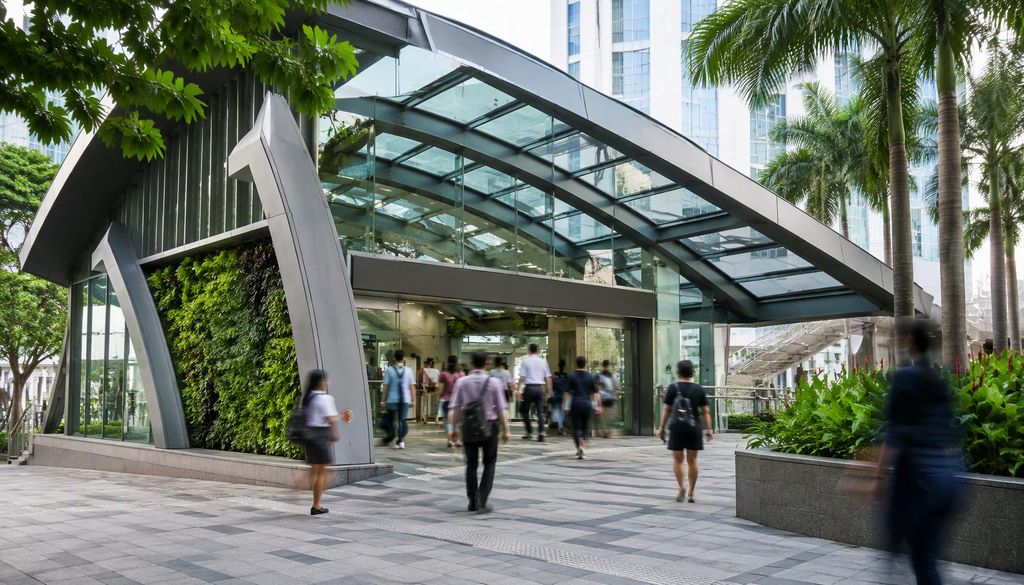
Why interchange status matters — and how to read it honestly
A station with two lines is not merely twice as good. It changes the geometry of every journey: more destinations without a transfer, a fallback route when one line falters, and a wider pool of tenants and buyers for whom the address works. Homes near stations that gained a second line have, as a historical pattern, tended to hold their values more firmly through soft patches than comparable homes a stop or two away on a single line.
We want to be careful with that sentence, so here it is again with the handbrake on. It is a pattern observed across past openings, not a law, and definitely not a promise about any specific property. Plenty of interchange-adjacent homes have gone sideways; plenty of single-line homes have done well. Line openings are one variable among many: supply, rates, the broader cycle. Any agent who converts a railway map into a guaranteed return is selling you something other than analysis.
What we can say with a straight face: the buyer pool for a home near an interchange is structurally larger than for the same home near a single-line station, and that depth tends to matter most exactly when the market thins out.
The timing quirk that favours this project
Here is the part of the calendar worth circling. Lorong Puntong Condo’s estimated TOP sits around 2031 to 2032. Analyst estimates, not developer commitments. CRL Phase 1 opens in 2030. Do the subtraction: by the time buyers here collect their keys, the interchange has already been running for a year or more.
That sequencing is rarer than it sounds. Most near-MRT projects ask buyers to endure years of construction dust, diverted footpaths and night works before the benefit arrives; the neighbourhood absorbs the pain, then the value, in that order. Residents of the existing estate around Bright Hill are living through that now. A future Lorong Puntong owner skips the first half of the trade entirely: no hoardings outside the window, just two working lines from day one of keys.
None of this appears on a price list. It should appear in your thinking. The five-to-six-minute walk to the station, the 2030 opening, the 2031–2032 estimated completion: three separate facts that happen to interlock unusually well. Our location guide maps the walk in detail, and the project details page tracks the timeline as it firms up.
One practical note for households planning around school and work. Ai Tong parents will still walk: 330 metres beats any train. The interchange’s daily value shows up elsewhere: the spouse who works in Defu’s industrial estates, the teenager headed to a school along the eastern stretch, the weekend trip to Loyang that stops requiring a car. Two lines will not change where you live. They change how many places count as close.
Sources: LTA: Cross Island Line · LTA: Thomson-East Coast Line
Be first through the showflat doors.
Registrants receive the official project name, floor plans and price list the moment the developer releases them, plus priority showflat slots. No obligation, no spam.